The Weekly Newsletter of Chubeza Farm
FABULOUS FENNEL
We're still enjoying last week’s wonderful rain! The air is clean, the soil is saturated and quite content, and our vegetables are taking their time to grow. One plant that particularly gains from such showers is the amazing fennel – the Chubeza Vegetable of the Week – which fattens up and cheerfully thrives. It’s time to tell the Fennel Story, as we thank Hannah Netzer for her beautiful photos from our field.

Fennel belongs to the carrot (Umbelliferae) family, a relative of the dill, coriander, carrot, parsley, celery, anise, cumin and others. The fennel’s origins are in the Mediterranean basin– a neighbor! Being well-accustomed to our surroundings, fennel grows peacefully and comfortably in wild fields, handily overtaking abandoned agricultural plots and the random open urban lot. It understands our fickle weather, demands order from surrounding weeds that dare to encroach on its territory, and stretches upward toward the winter sun to reach a height of some two meters! Fennel is indeed a strong, resilient plant: it successfully endures weather fluctuations – even extreme ones (perfect for the Israeli winter), and hardly suffers from pests, perhaps thanks to its pungent scent. Once established, fennel gets along well with the weeds, staking out its own territory. Fennel’s dominant nature is the reason gardeners recommend giving this veggie its own turf in a bed free of other plants alongside, though we at Chubeza have not noticed our fennel harming its neighbors.

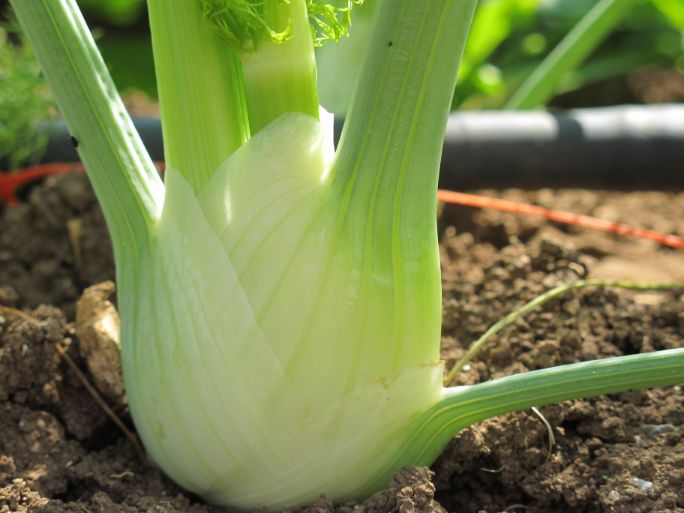
Contrary to other cultivated vegetables, the Florence fennel we grow is not dramatically different from its wild fennel brother, except for being shorter and directing most of its energy into thickening the leaves at its base into a bulb-like structure: a white, sweet and juicy mass which we eat. Here too, it’s a mistake to think we eat the fennel’s root or bulb. In fact, we’re eating the lower leaf stalks that grow from the stem base, which in the cultivated fennel become swollen and fleshy. These leaves taste milder and sweeter than the wild or common fennels grown mainly for seed production.
Fennel’s distinctive aroma and taste derive from a unique phytochemical, anethol, the main component of its essential oil (also found in anise). This compound helps retard inflammation and may lower cancer risk. Fennel’s essential oil may also protect against various chemical toxins in the liver and other organs. Its strong scent can be used to freshen breath (if you fancy its aroma) and is a common ingredient in natural toothpastes. Those who do not tolerate the smell can identify with the insects who keep their distance from fennel, and with medieval witches who were scared off by sheaves of fennel and St. John’s wort traditionally hung over doorways during June 24th European midsummer agricultural summer festivities.
But let’s continue to sing its praises……
The ancient Roman writer Pliny the Elder wrote highly of the fennel. He attributed 22 medicinal uses to fennel, including the fact that snakes eat it during shedding season and sharpen their eyesight by rubbing up against the plant and using its juice. Fennel was considered an important medicinal herb, one of nine Anglo-Saxon sacred herbs (along with mug wort, plantain, watercress, betony, chamomile, nettle, hawthorn, crabapple and chervil). Its essential oil is primarily concentrated in the seeds, which are a key ingredient in various Chinese, Bengali, Indian, Chinese, and other spice blends.

And a little more flattery: the fennel’s main claim to fame is as a digestive aid – thanks particularly to its seeds. In India it is often served at the end of a meal (in Indian restaurants, fennel seeds may come with the bill, in place of sticky toffee) and chewed to help freshen the palate and “settle the food.” Perhaps this is one reason fennel is considered helpful for weight management. The leafy edible bulb is rich in dietary fibers which in themselves contribute to efficient, healthy digestion. Fennel is also recommended for colicky babies.
Even I drank the… hmmm, how shall I describe it… bold-tasting brew, composed of fennel seeds and star anise, to help my firstborn Neta through colic spells. Young mothers, famous for their willingness to do whatever it takes, will be rewarded twofold by imbibing fennel: helping the baby’s digestion and stimulating their own milk production. And if that still doesn’t work and the baby keeps screaming, fennel tea is said to soothe a sore throat, relieve hoarseness and coughs…

But fennel has a dark side as well, depending on how you look at it. It is one of the herbs used in the production of absinthe, a highly potent alcoholic liquor made from wormwood, hyssop, anise, lemon balm and fennel. Absinthe’s anise-like flavor and green hue have earned it the nickname “the Green Fairy.” Absinthe has long been associated with hallucinations (or artistic inspiration, depending on who you ask) and was quite popular in the 19th century among bohemians and artists, with Vincent van Gogh being a major aficionado. Some claim that he cut off his ear while under the influence of absinthe.
Oh, let’s forget about hallucinations for a minute, and take a deep breath of fresh air. If you’ve decided to go out picking wild fennel flowers, you can add them to vinaigrettes, salads, soups and sauces. Finely chop fennel blossoms (or crush them with a mortar and pestle) and mix with soft butter for a great spread for grilled fish or chicken. The flowers also make a lovely, dramatic garnish. Fennel seeds are best collected immediately after the flowers have bloomed, while they are still green and fresh.
This week we're really not asking for much. We simply wish you all a pleasant winter week and the continued blessings of abundant rain. Enjoy it all in good health!
Alon, Bat-Ami, Dror, Einat and the entire Chubeza crew