The Weekly Newsletter of Chubeza Farm
THANK YOU!!
One hot summer day this week, I found myself reflecting on the glories of summer, when so many people take off on journeys across the globe. And – right now, your Chubeza boxes abound with vegetables that reached us from those same far corners of the world. Amazingly enough, many of the summer vegetables we view as quintessentially Israeli or Middle Eastern were completely unknown in the West before the uncharted territories of Africa and America were “discovered” in the 15th century. Take tomatoes, zucchini, pumpkins, corn, potatoes, peppers and sweet potatoes, for example – not one of these tasty veggies appeared in the European or the Eretz Yisraeli vegetable garden before the discovery of America. Okra, garlic and watermelon, on the other hand, were born in Africa and had migrated here long beforehand.
The thought of life bereft of the redness of tomatoes, the green of corn husks, the orange of pumpkins and sweet potatoes or the juiciness of ruby-red watermelon reminds me of black and white TV. Once again, the vegetable patch urges us to seek humility (always a good idea), to feast our eyes on the rich abundance of a lush, colorful summer season, to understand a thing or two about the beauty and wonder found in diversity – and how much we can all gain and enjoy when we allow diversity to flourish.
(Check out this very interesting article from Masa Acher (Hebrew) about the global culinary migration revolution.)
One of these migrants from the American continent is the pepper, the star of this week’s Chubeza Newsletter!
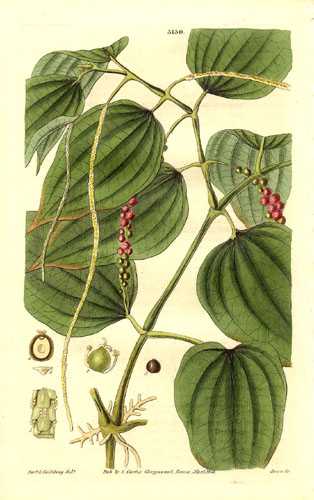
The pepper we eat as a vegetable – sweet, hot, red, green, yellow, or orange (also available in purple, black, and brown) – was named by mistake. The word “pepper” originally referred to the spice (black or white pepper) and only later was lent to the chili and green peppers.
Black pepper (a member of the Piperaceae family), is a hearty climbing plant whose black, green or pink seeds – at various stages of ripening – are ground into the savory black or white pepper condiment we know and love. It originated in India, with its name derived from the Sanskrit pipali. Europe was already well-acquainted with the pepper from ancient times, as well as its relative, the long pepper (piper longum), which was also used as a very piquant, red-hot spice. Along the commerce route, the name morphed into Latin piper then Old English (pipor), German (Pfeffer), French (poivre), Dutch (peper), and other languages. Simultaneously, the word travelled from Indian languages to Persian to Aramaic, eventually becoming known to our Jewish sages as pilpelin or pilpelet. Pepper’s sharpness became synonymous with sharp wit and tongue, as mentioned in Talmudic Aramaic as pilpula. Pepper’s sharp taste made its name synonymous with sharpness of mind and speech – such as Talmudic pilpul, as well as to describe energetic, vigorous action.

When Christopher Columbus attempted to discover a shortcut to the Indian spice, he was unruffled by the fact that he found something totally different. He bestowed the hot, spicy vegetable he met in the Caribbean (from the Solanaceae family) the identical name as the fiery Indian spice he had met, thus confusing the world forever after. There is absolutely no botanical connection between the plants. Yet the American pepper was hot like the Indian one, and Columbus, a savvy marketing man, hoped to sell it for a pretty penny in Europe – so he called them by the same name. In his diary, Columbus wrote of its being “a spice better that our black pepper.” (“Our” black pepper?!!) His enthusiasm led the spicy hot pepper to travel via Spanish and Portuguese maritime routes to Europe, Africa, Southeast Asia, India, and of course Hungary, where dried ground pepper, aka paprika, became the national spice.
Soon enough, it was discovered that this hot pepper had a sweet little brother, (actually quite a few sweet siblings), but by then their fiery, peppery name was already a household word. In Italian, they were coined “sweet peppers,” and then in Hebrew gamba.
In Central America, this veggie has a long, ancient history. Petrified peppers have been found in archeological sites in Central America dating back over 2000 years, and they appear in coastal Peruvian embroidery relics from the first century. The Olmecs, Toltecs and Aztecs are just some of the native American cultures known to have raised peppers and used them in culinary endeavors. Along with the hot pepper varieties, sweet peppers were also brought to Europe. By the early 17th century, the Europeans had discovered the rich variety of the peppers we know and love today, all which had been cultivated for generations by the peoples of Central America.

Today there are hundreds of pepper varieties worldwide, spanning the taste bud gamut from sweet, bittersweet, hot, to sweet-and-spicy, etc. There are also a host of shapes: long and wide; square (slightly bell-shaped, hence “bell pepper”), small and heart-shaped (the Spanish pimiento); long and yellow like a banana; tiny ones for pickling; long and narrow, small triangular ones, and even string-thin. The colors also vary: peppers usually begin in various shades of green, from light to dark, but not always. When I worked in California, we grew a pepper variety which was initially purple on the outside and green on the inside! As the pepper ripens, similar to a tomato, its sugar level (or heat level) spikes, and it shifts to a warmer hue: yellow, orange, and of course, red, with black and maroon also available. Sweet and hot peppers are harvested at different stages of their growth – from green to red, granting us a broad range of flavors and colors to love and enjoy.

Planting peppers was actually the first work that Alon and I did together, when he joined me in spring 2004. Back then we planted the peppers in Chubeza’s open field. Today, the first spring plantings are pampered in a growth tunnel – with protective mesh walls, shade netting overhead, and trellising strings to help guide the plants to stand tall and climb high. Like beloved, well-tended offspring, they yield wonderful, heart-lifting fruits that make all the effort worthwhile. Still, we maintain some open-field growth as well. Late spring and early summer plantings sometimes struggle inside the growth tunnel, so we escort them to be planted in the more ventilated open field. Even there, we pamper them: we grow the pepper beds between two beds of Thai lubia, which boldly climb up trellis nets on either side. Between the two tall beds, we stretch shade netting to protect the delicate pepper foliage from various diseases, leaving the fruits exposed to sun damage.
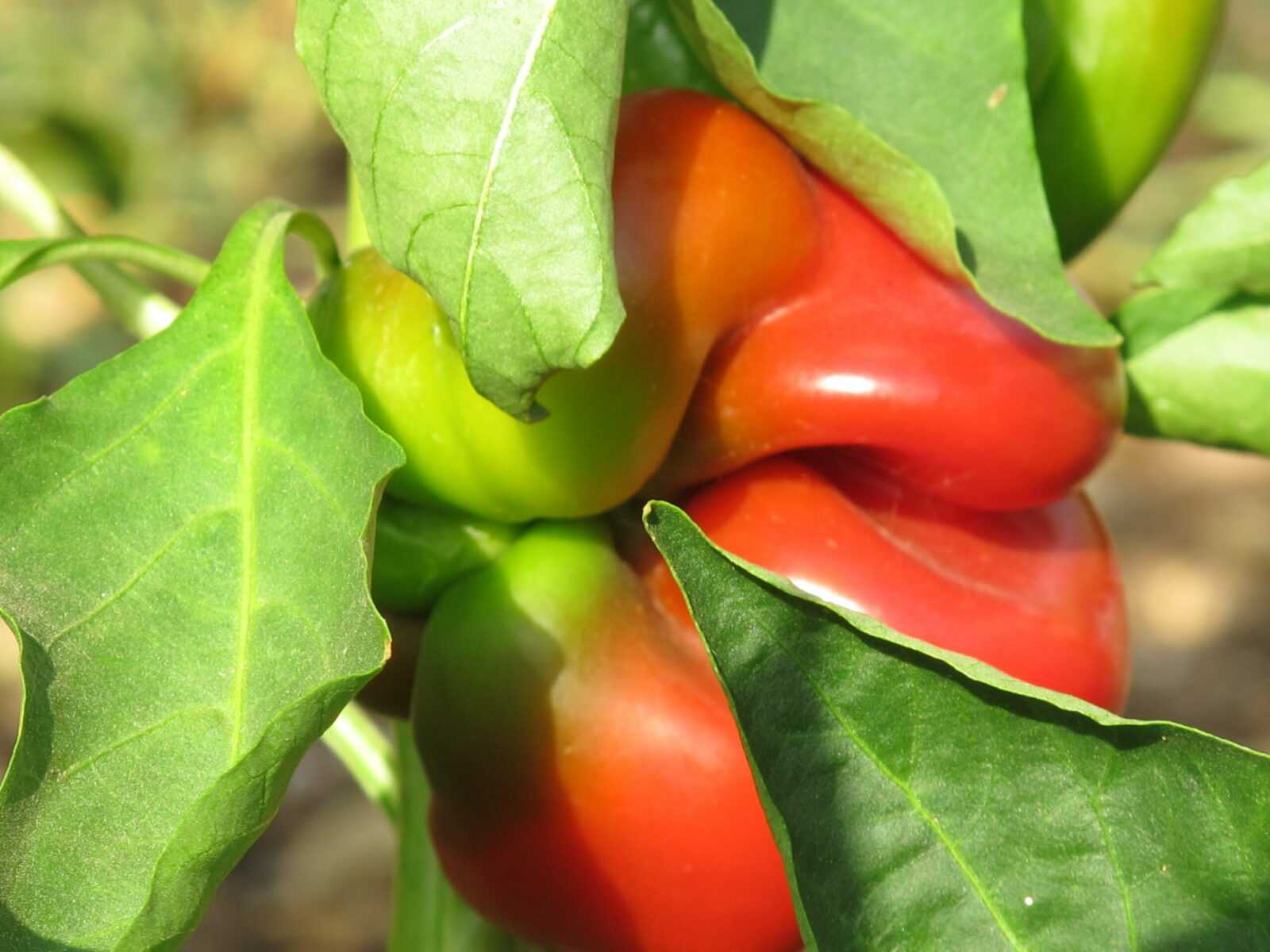


Sometimes, we start the first pepper harvest by picking green peppers. Pepper picking is essentially both harvesting and thinning. While picking green peppers, we take several fruits from the denser areas of each plant to give the remaining fruits more breathing room and space to grow. Upon ripening, the green peppers begin turning red, first one cheek, then the other, until slowly becoming blanketed beneath a blushing red cover. The process takes about three weeks. Now, as we harvest the peppers, we choose only those that have almost fully reddened. At the end of the harvest, green and half‑red peppers remain on the plants, waiting patiently to redden by the next picking.

In recent years we’ve also been growing a hot pepper of the “Lapid” variety. Our Thai workers have long been cultivating small, red‑hot Thai chili pepper plants for their own use, so we decided to take our cue from them and try to expand into the hot realm… but gently. Thus, Chubeza’s variety is not super-hot and is not very small. This week we added this new variety to some of the large boxes. Try it and see if you like it. If you do, you can add this hot pepper to your box as an extra item through our ordering system under “Chubeza Vegetables and Fruits.” Here’s a glimpse of the guy:
Peppers of all varieties are very rich in vitamin C, making them natural anti-aging agents and beneficial in preventing heart and vascular diseases, as well as certain cancers. Vitamin C is essential for proper immune system function, and augments iron absorption in the intestine. Another key pepper component is vitamin A, an antioxidant which protects body tissues and cells from oxidation. Vitamin A may also aid in the prevention of cancer and cardiovascular disease and slow aging processes. Vitamin A is essential for night vision and vital for the proper function of the immune system, cells, mucous membranes, and skin.
To cook or not to cook peppers, that is the question. During cooking, much like what happens with tomatoes, the pepper’s vitamin C levels decrease. But simultaneously, the red pepper’s levels of the crucial antioxidant lycopene double in cooking. So, the answer is... both!
May this week be quiet, peaceful, and cooler than stifling! Enjoy!
Alon, Bat-Ami, Dror, Einat and all of us at Chubeza