The Weekly Newsletter of Chubeza Farm
THANK YOU!!
Over the past weeks, your Chubeza boxes have been graced by white flowers which don’t exactly look like flowers, but that’s precisely what they are – a dense cluster of flower buds yet unopened. You know them well as a cauliflower head.
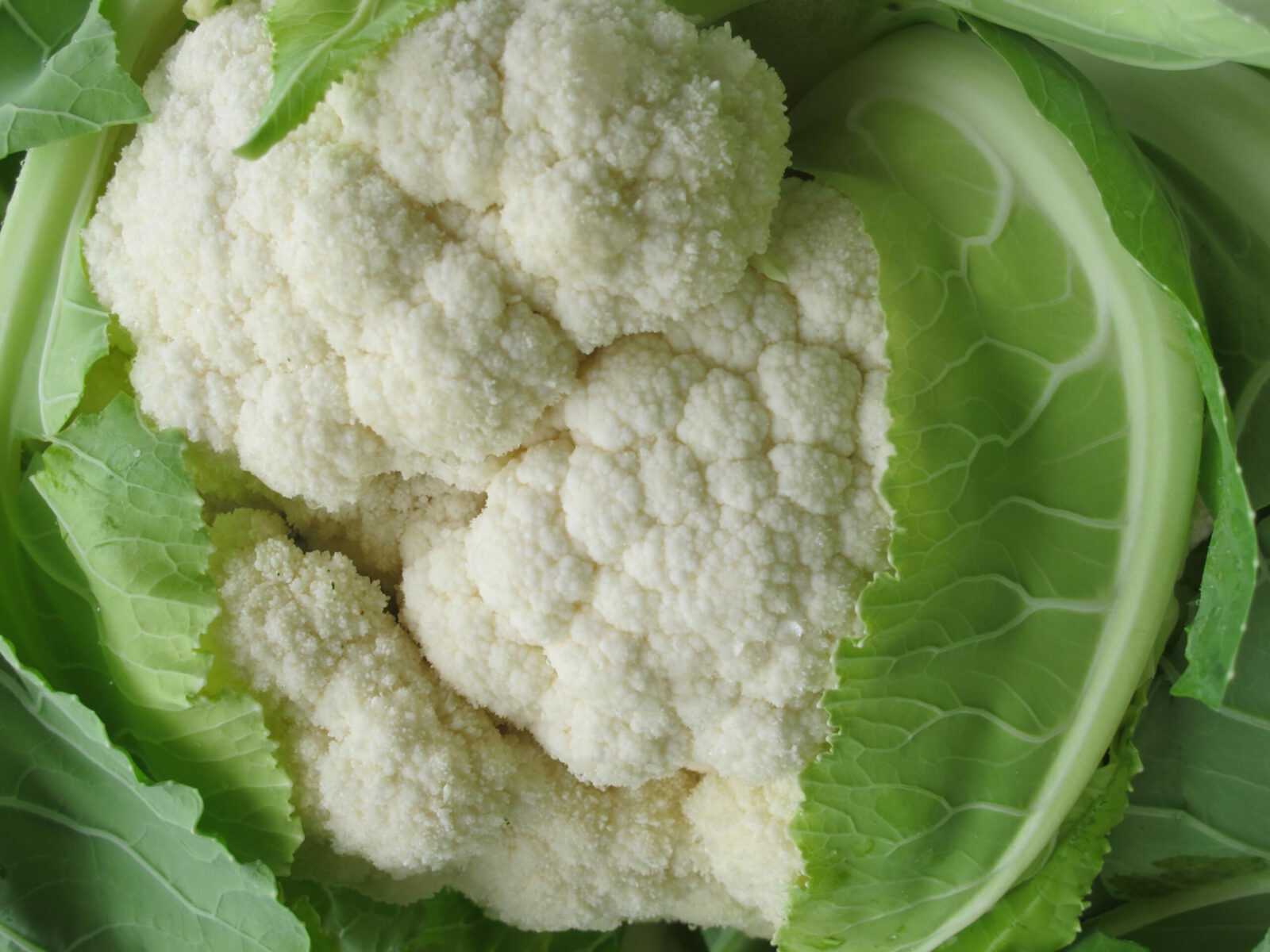
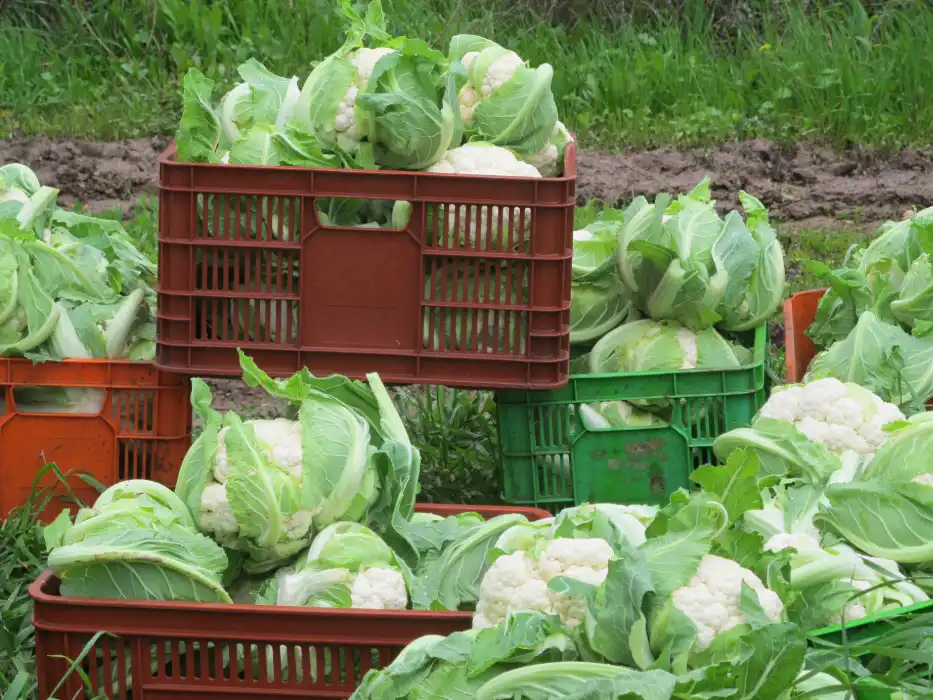
Cauliflower’s Hebrew name (kruvit) was coined by Eliezer Ben Yehuda, derived from its sibling the cabbage (kruv). Its English name reflects a similar lineage: cauliflower = the cabbage flower. Rightly so, since cauliflower was likely developed from wild cabbage. This happened during the Roman era in the Mediterranean basin (Greece/Italy/Turkey—not exactly clear where), and from there, cauliflower spread to Europe, the Middle East, India, and China.
When I say “developed,” I mean developed by human beings, almost like a modern agricultural start-up, only much, much slower. Some of the most extraordinary successes in developing new varieties did not result from structured, funded research, but rather thanks to the simple act of a farmer collecting and saving seeds from the plants he/she favored and preferring them over less-appealing seeds. This simple act of selecting one plant over another had a tremendous impact on improving and transforming a particular variety or crop. Long before humans understood plant genetics, they instigated gradual, small-scale changes in plants that accumulated over time, yielding genuine results.
Cauliflower and broccoli owe their existence to farmers (or perhaps to their wives and children who were growing bored of cabbage pie) who developed a craving for the immature flower buds of the cabbage. They selected plants that produced large flowering heads, harvested their seeds, and replanted them the following season. And this is how cauliflower and broccoli evolved – both are variations of undeveloped cabbage inflorescences. The cauliflower’s precise name is var. botrytis, meaning “cluster” – due to its resemblance to a grape cluster. (Broccoli, developed in Italy, earned the title var. italica).
Cauliflower thrives in cooler seasons. At Chubeza, it grows best in the winter. Over the years, we have learned to plant the first seedlings in August, followed by continual plantings from August through December. In August, we plant heat-tolerant varieties, transitioning to winter varieties from September.
Like all members of the cabbage family, cauliflower consumes a great deal of nitrogen. Thus, it’s essential to grow cauliflower in fertile soil enriched with compost, preceded by legumes or green manure crops that enrich the soil with nitrogen. After growing cauliflower (and other brassicas) in Chubeza’s field, we then aim to grow less nitrogen-demanding crops that can thrive in soil recovering from high nitrogen consumption. The cucurbit (gourd) family, which grows in spring and summer following the cabbage season, is an excellent example of crop rotation after brassicas.
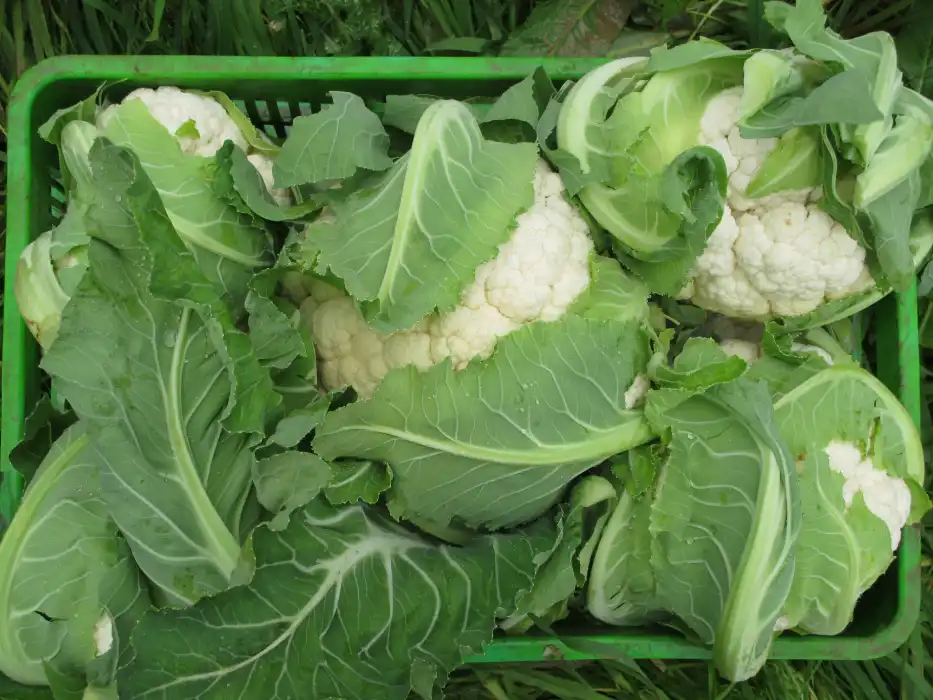
As for cauliflower, like broccoli, we actually eat the curd (a type of inflorescence) composed of flower buds, their stalks, bracts, and densely packed inflorescence branches that have thickened and become fleshy. As the cauliflower grows, this “scalp” is surrounded by a dense circle of leaves that close around it, just like cabbage leaves close around the head. These leaves curve slightly inward, protecting the developing cauliflower, shielding it from sunlight, and thus blocking chlorophyll formation and maintaining its white color. This is why when we farmers select a cauliflower variety, we give preference to one whose leaves close well around the inflorescence. Sometimes, when the farmer notices that the leaves fail to do their job, he or she walks through the rows and ties the outer leaves with rubber bands to wrap the exposed cauliflower and protect it from the sun.
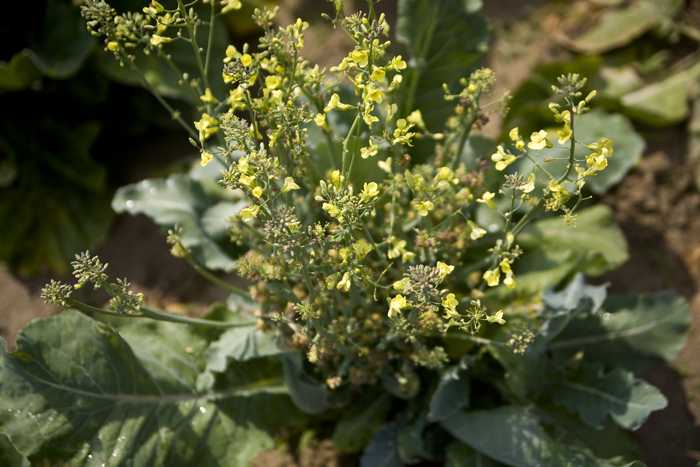
Unlike broccoli, which develops additional side heads after the main head is harvested, cauliflower produces only one head in the center of the plant and stops yielding altogether after that single harvest. The cauliflower is usually harvested when it reaches its maximum size, while remaining compact and firm (or when we notice the leaves beginning to open, threatening cauliflower “sunburn”). If left in the field, the inflorescence will begin opening and separating, in preparation for the blossoming of tiny yellow flowers, like a great big bouquet.

The cauliflower that we know and love is mainly white, and I’ve told you how much effort we invest to keep it bright and shiny. But cauliflower also comes in varieties sporting such diverse hues as purple, greenish, orange (rich in beta-carotene) and a weird green model resembling an Escher creation or a UFO. Despite their different shapes and fluorescent hues, these cauliflower varieties are not genetically modified. They were developed via the ancient, traditional method of selecting plants from certain varieties and crossbreeding them until a very special colorful variety evolves. Creations of such varieties can take several decades. The result is amazing and new (even sorta’ psychedelic….).
Cauliflowers (of any shape or color) should be stored in the refrigerator, wrapped in an unsealed plastic bag (to allow sulfur to escape, preventing the cauliflower from turning black), with the stem downward and head above to prevent moisture accumulation on the curd. Stored correctly, cauliflowers can keep for a week or two, but they’re at their tastiest during the first few days. Afterwards the sweetness diminishes.
As we send you white flowers of hope in your boxes, we continue to wait for the speedy return home of all the hostages.
Alon, Bat-Ami, Dror, Einat, and the entire Chubeza team