The Weekly Newsletter of Chubeza Farm
THANK YOU!!
Along with the bountiful array of large and small greens in Chubeza’s winter boxes, it’s now the time for some wonderful fresh herbs to shine. Each week, we try to send you at least one member of the familiar, ever-vibrant duo: parsley or coriander (and sometimes dill as well). They do grow nearly all year long – parsley being the hardiest of the three – but you can’t compare the wilted summer coriander to the vibrant, dynamic winter version, nor the small, stubborn heat grown parsley to the soft, lush, vigorous winter parsley. In the coming newsletters, we’ll share fascinating new aspects about these familiar, essential herbs. Enjoy!
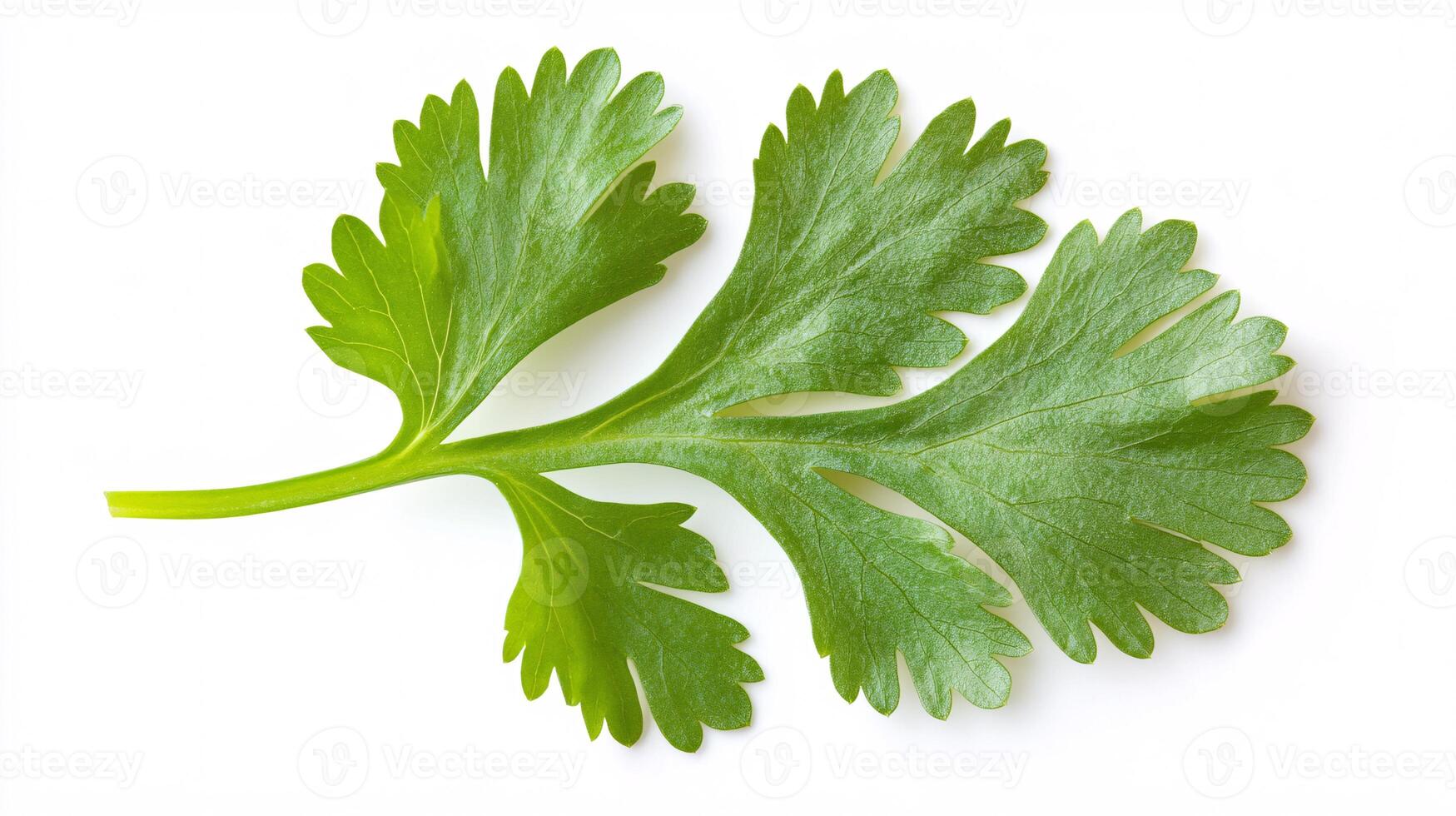
“And the manna was like coriander seed, white, and its appearance like bdellium” (Numbers 11:7)
Winter is tricky for us farmers playing the guessing game, studying the various forecasts and hoping that “our number” comes up. Will it rain this week? How much? Will it be dispersed evenly over the hours in gentle, moderate showers, or douse the earth in one furious blow? This may well be how gamblers feel – placing their chips on Lady Luck, which unfortunately has not always been generous with her wet rewards to us…
Of course, the lack of rainfall can be scientifically explained, with global warming or desertification or any other scholarly rationalization. But to deal with this reality, we take our cues from the heavy gamblers – cross our fingers, make vows, pray hard and above all, hope for abundant drops of luck.
At Chubeza, we actually grow an herb whose Hebrew name denotes “luck” or “fate,” and whose reviews are controversial. Introducing the star of this week’s Newsletter: Coriander, the “lucky charm of the field.”
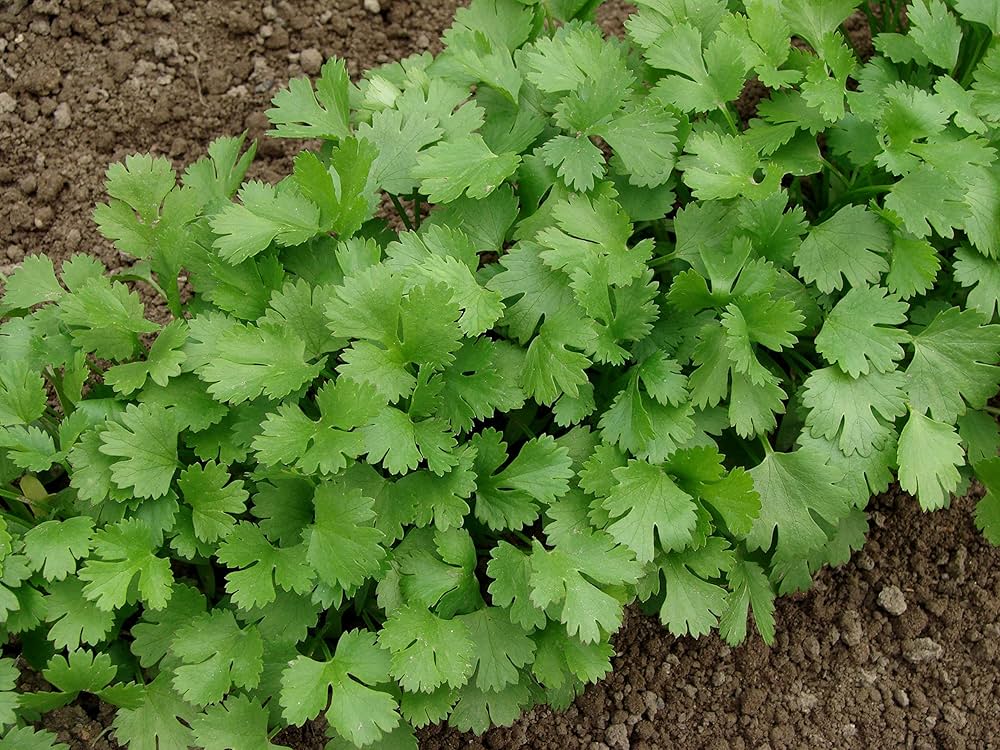
Fate can be favorable – and then it’s “lucky.” Or bad, which makes it “fatal.” Coriander fits this dichotomy, as it is a particularly fatal herb. Almost every discussion about coriander begins with a sentence like “the world is divided into those who are crazy about it and those who despise it.” Like many foods, the “kill for” or “die of” attitude begins before the first bite, i.e., when the food’s scent is inhaled.
Coriander’s unique aroma originates from powerful aldehyde molecules – some boasting a fresh scent, others a soapy smell. Some noses perceive this scent as fresh and green, while others interpret it as foul, soapy, dirty and disgusting. Till now, the difference was explained as an acquired preference, perhaps shaped by childhood experiences or early encounters with coriander’s fragrance. However, new research has examined love/hate of coriander using genetic variables, concluding that it’s actually an innate preference, dependent on the presence of a specific gene responsible for creating odor receptors for aldehydes. People with certain receptors pick up pleasant aromas that find coriander fresh and tempting. Others with different receptors perceive this scent as a real danger, recoiling as if it were poisonous. The good news is that despite the genetic tendency, change is indeed possible. Genes only partially determine coriander aversion, and even those born with a dislike can learn to savor it.
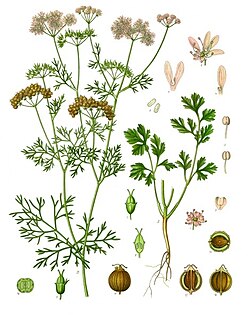
Whoever gave coriander its Hebrew name probably belonged to the pro-coriander team. The manna eaten by the Israelites in the desert is described as “white, like coriander seed, and its taste was “like wafers in honey.” In Targum Jonathan, the seed that gave the manna its shape is identified as coriander seed, thus the plant received the name gad hasadeh (“luck of the field.” (The color of the manna, however, was white, not the light brown typical of coriander seeds.) Coriander’s more popular Hebrew name, kusbara, comes from the Mishnaic Hebrew (kusbar), the Aramaic (kusbara), and the Arabic (kusbara), all of which likely inherited it from Sanskrit (kostumbari or kostumburu). Its English name coriander comes from the Greek word for bedbug – koriannon – apparently because of their similar scents…
Legends about the miraculous manna purport that when it was eaten, its taste matched whatever the eater was craving at that very moment. This association with coriander may seem a little strange to some of you, but it is indeed a multi-talented seasoning herb. On one hand, it adds a distinctive taste to salads and various dishes. On the other, it tempers the intensity of hot spices, making it a mainstay of the Asian and South American cuisine which “likes it hot.” Coriander seeds also appear in a magical delicacy, the sugarplum, which started out as sugar-coated coriander seeds.
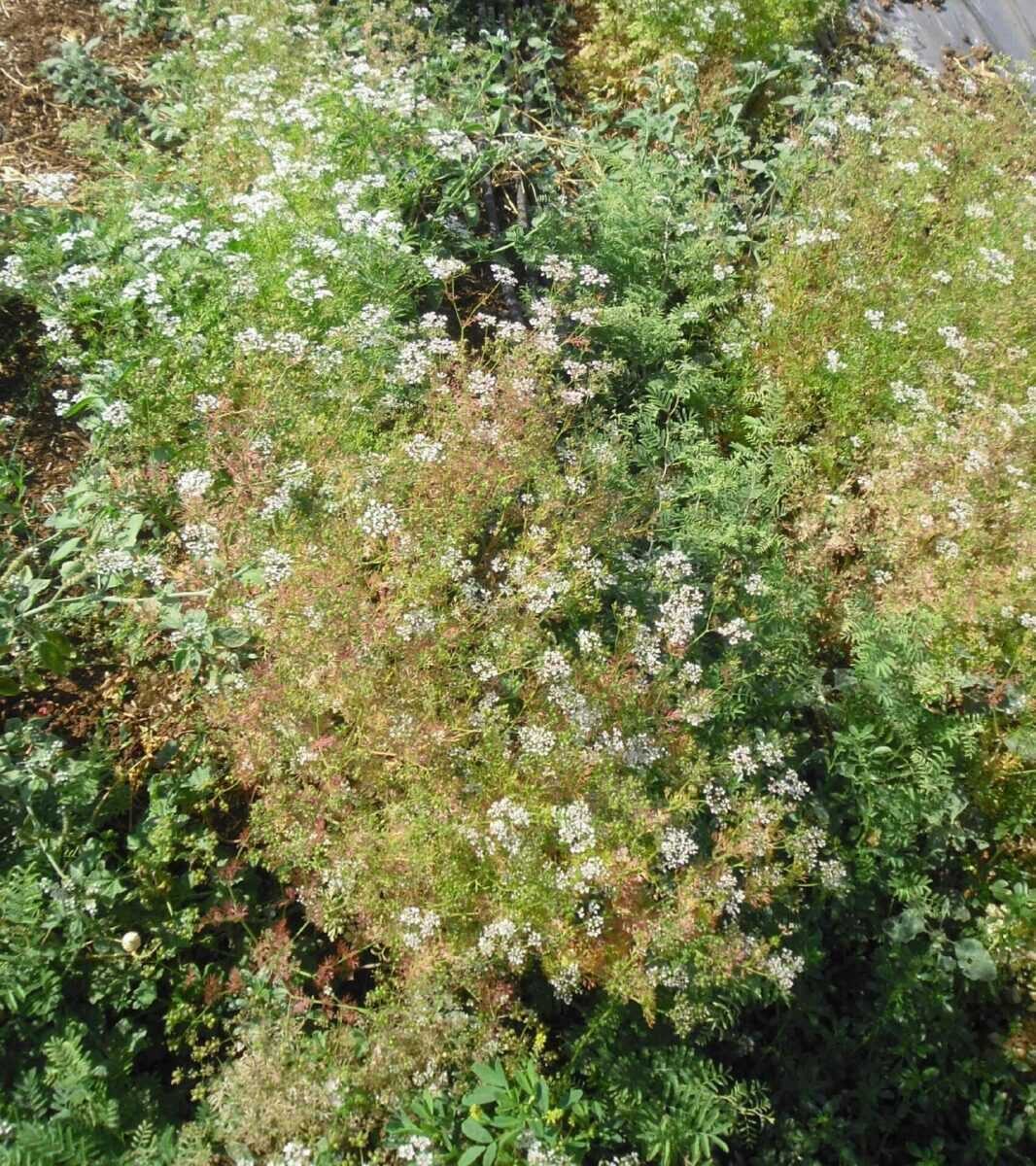
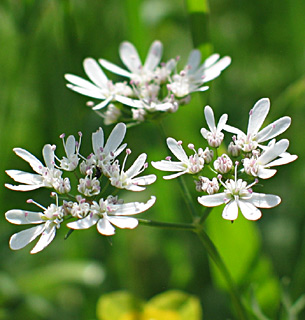
Coriander belongs to the Umbellifer family, sister to the dill, carrot, fennel and others. The family’s name was coined from the shape of its flowers, resembling small parasols or umbrellas. Several smaller stems emerge from the main stem branch, and from them more sub-branches, forming a canopy. Unlike the biennial parsley, which can be harvested many times before flowering, coriander allows only a limited number of harvests (1-3, depending on the season) before sending up a flowering stalk. In wintertime this process is slower, and in summer we sometimes can’t harvest it fast enough before it blossoms.

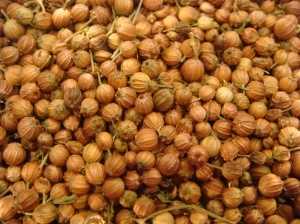

This distinct herb originated in the Mediterranean Basin, but today it is an honored citizen in almost every kitchen in the world. Coriander is generously sprinkled over dishes in Iran, Georgia, the Caucasians, in Morocco and Arab countries, plus certain parts of Africa. And of course, coriander is king in India, China and Thailand. In Mexico, you’ll hardly find a dish without it.
Coriander is one of those streamline-built plants where you can make use of all its parts: the leaves, stems, and even its root. The root can substitute for garlic and is especially popular in Thai cuisine, though it was once used as “bitter herbs” on the Seder plate instead of a horseradish root. Coriander leaves are the part you’re familiar with – the source of the dominant taste and aroma that stand at the crossroad of the coriander love/hate divide. The seeds, however, are milder, sweeter and more aromatic, and an excellent seasoning herb for preserves and for long cooking.
Another attribute of coriander has been known in folk medicine for years: it helps ease insomnia and anxiety. It is also known to aid digestion: Adding coriander to legume dishes (pea soup, bean stews) helps reduce the gas they tend to produce. In medicine, coriander seeds are used in laxative preparations and for treating stomach ailments (digestive issues, gas, and preventing intestinal spasms). Steep 5 tablespoons of coriander seeds in a liter of boiling water, sweeten with honey, let sit for about 5 minutes, and drink 1–3 cups a day as a medicinal tea.
The main medicinal use of the plant is in the essential oil contained in its fruits. Its primary component, linalool (also known as coriandrol), is used to produce vitamin A capsules and in preparations for treating constipation and cleansing the stomach (for example, before X‑ray imaging and surgeries). The same property that likely helped Roman soldiers preserve meat is probably the one that helps kill intestinal worms, bacteria, and parasitic fungi (such as the notorious E. coli). Recent studies have found that while regulating stomach activity, coriander also binds to toxins in the body and carries them out, thus making it effective in cleansing the body of toxic metals such as mercury, lead, and aluminum.
Now there is scientific support for what folk medicine has known for years: coriander aids in the treatment of diabetes. Research has found insulin-releasing and insulin-like activity in coriander. It has been proven to be Hypolipidemic, i.e., reducing the amount of fat in the blood, thus preventing bad cholesterol and assisting in the prevention of diseases of the blood vessels.
Reading about all these amazing qualities of the “lucky charm of the field,” coriander lovers can simply rub a leaf, inhale the aromatic scent and add it to any salad or dish. We also invite die-hard coriander loathers to take the plunge (maybe while holding their breath) and add some of this wonderful manna to their plate.
May we be blessed with joy, health, and blessed rains!
Alon, Bat-Ami, Dror, Einat and the entire Chubeza crew