The Weekly Newsletter of Chubeza Farm
THANK YOU!!

This past week, it looked like summer had landed upon us with a "boom," with the heat soaring to summer temperatures. But much cooler weather is waiting in the wings. This is all part of the familiar springtime weather seesaw, which this year pushed off with the powerful boost of an early heat wave. Indeed, spring’s official arrival will be marked on March 21st. Chubeza’s field is already planted with a host of spring and summer crops—beginning with the squash family: melons, zucchinis, fakus (a type of cucumber), pumpkins, butternut squash, and acorn squash, to now be joined by eggplants and watermelons. We started harvesting zucchini last week! The spring cycles of onions, corn, and beans have been planted and are just beginning to sprout. And, of course, the field is still bounding with many winter vegetables, which will be the big winners of this week’s cool weather forecast.
One of the vegetables that heralded autumn’s arrival and will stay with us until almost the end of spring is the sweet, beautiful beet. This superb veggie enriches our world by adding both flavor and color to life. So, in its honor, this week’s Newsletter is a tribute to The Beetroot.

The first chapter in the Annals of Beet History is actually the history of leafy beets, or chard, the beet’s immediate relative and likely its older brother. Their common ancestor is probably the wild beet which grows along the Mediterranean coast, whose leaves and stems were gathered by early foragers. Naturally, the first farmers to deal with the beet attempted to cultivate a plant that yields large leaves and wide, plump stems, i.e., the chard. These farmers were probably Greeks and Romans living along the Mediterranean coasts. One theory suggests that the family received its name beta because its seed pod resembles the Greek letter Beta. The Hebrew word for beet, Selek, derives from the Arabic Salak.

The beetroot became edible only around the second and third centuries. The first beetroot recipes for the Roman kitchen appeared around that time, some touting such praise as “better than cabbage!” In the beginning, just young wild beet roots were gathered and cooked, and only in the 16th century do documents appear attesting to a genetic mutation in the seeds that arrived from Italy to Germany and created: the beetroot. To this day, one of the beet’s nicknames is “Roman beet.” Even then, it was a rare vegetable in Europe. At the start, beetroot was primarily used medicinally. Red beetroot was known to be beneficial in treating amoebic or bacterial dysentery, internal injuries, nasal congestion and jaundice. Only in the 19th century did its culinary virtues gain renown.

The beet family seeds deserve a few words as well: the beet or chard seed is actually a cluster of seeds tightly packed together inside the dry fruit. Thus, when seeded, it will grow several sprouts at once, meaning they must be thinned upon germination. (Some seed companies separate the seed clusters and offer single seeds to allow precise planting and reduce the need for thinning. But we stick with nature…). Where thinning is not done immediately, you can harvest the 10 cm-high plants whose leaves are ready to be cooked or added to a salad. Usually the seeds sprout slowly, each at its own pace, over an extended period, creating beets of various ages and sizes. Thus, when we harvest them, we scan the entire bed and pick the biggest roots during each season, creating more space for the remaining roots to grow.
In folk medicine, often referred to as “like cures like” (similia similibus curentur), the belief is that plants represent their medicinal use based on their shape, color or resemblance to body organs. The red beet is seen as a remedy for treating blood circulation. Contrary to the purple pigment of other vegetables (cabbage, onion, eggplant, lettuce, pepper, basil, etc.), the beet’s purple is quite unique. Its origin lies in the purple pigment category betalains, which boast strong antioxidant properties and are potent fighters against cancer and heart diseases. The beet also contains salicylic acid, an aspirin-like compound which is anti-inflammatory and contributes to the vitality of blood vessels and the heart. The beet is considered one of the “cleansing” vegetables which is highly beneficial for the liver, kidneys, and even swollen legs and constipation.
In contrast to the internal cleansing that the beet offers, the external experience is quite the contrary. Beet cells are unstable and tend to “leak” when you slice or peel the root. Cooking helps stabilize the cells, which is why cooking the beet within its peel will reduce the staining. These pigments stabilize under acidic conditions, thus making pickling your beets a good (mess-preventing) idea. Beets don’t just stain your hands. We all know the red beet-dyed horseradish. Natural coloring powder extracted from beets is used as a popular food dye for pizza “tomato” sauce, pink lemonade or edible ink (the kind used to mark cuts of meat).
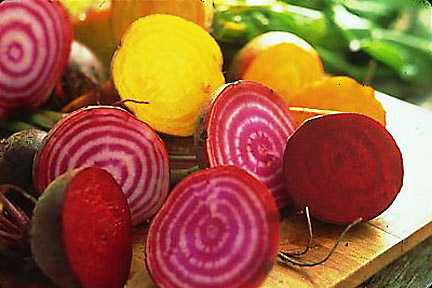
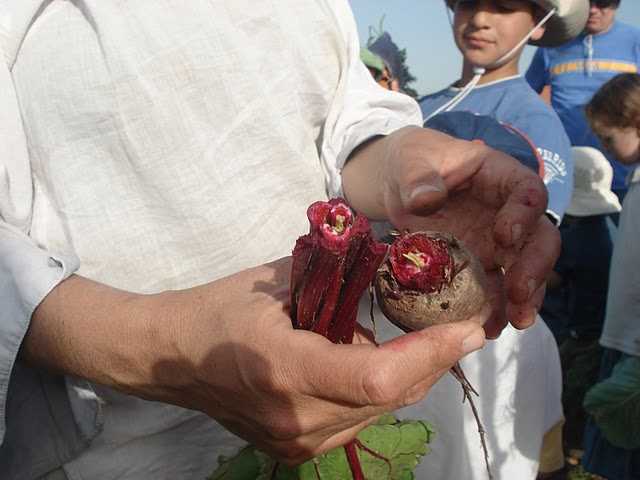
Beets are usually round and red, but not always. They come in various colors and patterns, from striped (chioggia) to yellow, white, and purple. And you’re already acquainted with the elongated Chubeza beet alongside its roly-poly brother.
Despite – or possibly because of – its very high sugar content (even higher than carrots and sweet corn), the beet is a dieter’s friend, containing only 30-40 calories. Plus, it is rich in folic acid, vitamin C and potassium.
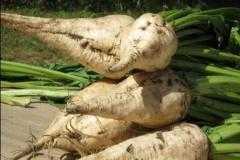
Another relative is a white-root sugar beet. From the time that the Crusaders returned from their journeys, they craved the sweet flavor of the sugar they had come to know and love. But sugar was an expensive commodity, imported to Europe via seafarers or travelling merchants. In 1747, German chemist Andreas Sigismund Marggraf succeeded in extracting a small quantity of sugar from beetroots, then used as animal fodder. However, the process was highly labor-intensive, and the sugar content in beets was low. One of his students, Franz Karl Achard, was more practical. He realized that if you want to extract more sugar from your beet, you have to create sweeter beets. He then crossbred white beets to create the father of the modern sugar beet:
Tips:
- To store beets: trim any greens (the greens draw moisture from the root and dry it out, like carrots or radishes), leaving about three centimeters of the stem. Do not cut the root. Store the beet in the vegetable drawer or an airtight container and wrap the greens in a towel and plastic wrap.
- To prevent “bleeding,” don’t cut or peel the beet prior to preparation. After boiling, steaming or baking, it will peel very easily.
- Adding some vinegar to the cooking water reduces the smell of cooking beets and helps preserve their color. The cooking water creates a clear beet stock which can be used for food coloring (like for rice, p’titim or couscous).
- Beets are naturally high in sodium, so avoid adding salt when cooking.
- When baking beets: to prevent staining, wrap in aluminum foil. It is best to add some kind of preferred seasoning in the foil, i.e., garlic, lemon slices, cumin or coriander seeds. The flavors penetrate and enrich the beet as it bakes.
- Beets can also be microwaved: pierce an unpeeled beet with a fork (to release steam), place in a microwave-safe dish, add a bit of water and heat uncovered for 4 minutes per beet, till soft.
- After preparation: to clean beet stains from hands, scrub with wet salt and lemon juice, then wash with soap and water.
- When our beets come with a bundle of greens, don’t trash them! Use the greens like spinach or Swiss chard for a great semi-sweet flavor.
We wish you all good news and the safe return of all the hostages.
Alon, Bat-Ami, Dror, Einat, and the entire Chubeza team