The Weekly Newsletter of Chubeza Farm
THANK YOU!!
Needed is healing, needed. Needed is healing, needed.
Needed is some strength to take me from here to a distant land or just to some nice place.
Needed is some secret that will reveal to me what else could happen and still befall me.
Needed are key words, and needed too is an understanding that healing takes a thousand times.
Needed is a supportive environment, also needed is guidance and the desire not to be alone.
Healing is needed.
Needed is the will to leave the sadness that has settled in the right chamber of my heart.
Needed is the will to get up, shake out the bed, go out and check what else there is to see.
Needed are joy and happiness, also needed are love, abundance, health, and more such things.
Needed is the will to get up, take part in life.
Needed is the will to be here.
Healing is needed.
I'm tired of a reality that is not good enough for me,
Some healing is needed,
And it's okay, it is near,
This is just the bad that comes before the good.
- Aviv Peck
When I was a child, we had the old-fashioned, innocent genre of children’s books at school, with stories in old-time, vintage Hebrew and naïve, brightly colored illustrations. I don't remember any of the stories, but I do recall one that was about turnips. The children in the story planted turnips in the garden or ate them for lunch. I can’t remember the plot, but I vividly recall our astonishment and wonder as children: what is this turnip?! It looked to us like some exotic European vegetable, grown in harsh winters (maybe the children in the painting were wearing coats?) with a heavenly taste (such happy children eating their turnip meal!).

It turns out that the turnip is a popular, well-loved vegetable that stars in many stories, even beyond my mysterious childhood turnip tale. For example, the classic Hebrew story "Eliezer and the Carrot" was originally the tale of a huge turnip that requires the entire family and household animals to band together to yank it from the earth. The story of “Jack-‘o-Lantern" (the source of the Halloween ritual of placing a lit candle inside a carved pumpkin) is based on an Irish folktale of “Stingy Jack,” who was cursed by the devil to roam the earth with a burning coal inside a carved-out turnip. Another story, penned by the Brothers Grimm, tells of two brothers, one rich, the other poor. The poor brother grew a massive turnip in his garden which he had no idea what to do with, so he brought it as a gift for the king. The king was so delighted that he sent the gardener home laden with treasures and gold. When the rich brother heard, his jealousy was so great that he, too, came to the king with a gift in hand: gold and horses. The king was so delighted with the second brother's gift that to thank him, he bestowed upon him one of his most recent treasures: a giant turnip...
Indeed, the turnip deserves a place of honor, and not only in legends - it really is a great vegetable. But, alas, it’s quite underestimated, perhaps because its taste is subtle and less sharp and pronounced as other vegetables. This is a true shame, because maybe we get so accustomed to tasting mainly intense flavors that we miss out on much more delicate, subtler, elusive, quiet tastes. Like those who do not grab the center stage, with loud, glittering attire - but sometimes really hold the true treasure...
The turnip is an ancient domesticated crop that was known in gardens of old in Greece, Rome, China, and ancient Egypt, after originating in China, Central Asia and the Near East. In Israel, turnips have been grown for some 2000 years, at least since the era of the Mishnah, which repeatedly mentions turnips as a common garden vegetable. In his book The Origin of Words, Avraham Shtal notes that the word “turnip” was apparently a general term for all vegetables, not merely the turnip we know today. Vegetables were once eaten together with bread to season and pique its taste.
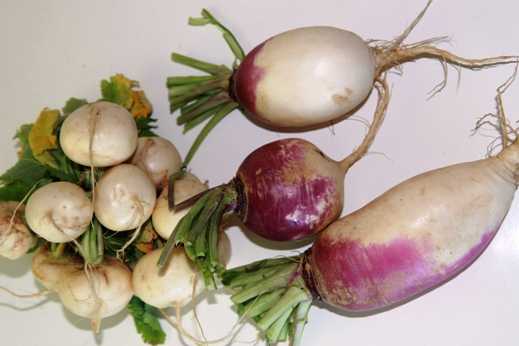
Turnips belong to the prominent Brassicaceae family, which includes cabbage, broccoli, cauliflower, kohlrabi, arugula, mustard greens, radishes and more. Like its family members, the turnip loves a cool winter climate, which slows its breathing and expands its volume of carbohydrate reserves, a process which improves taste. Varying, unstable conditions will produce woody roots and a sharp taste, and turnips will turn bitter in weather that’s too hot or dry. Perhaps this is also why turnips are harbingers of a real winter in Israel. The plants develop thickened roots and a fancy rosette of leaves on their crowns, similar to radishes. There are spherical, round, flattened and elongated turnip varieties, sporting a white, pink, purple or yellow hue.
In Israel, we mainly eat the turnip root, but in the Far East and the Southern U.S., turnip greens are also devoured with pleasure. Certain turnip varieties have been developed especially for their greens (similar to beetroots and beet greens). The turnip is eaten raw, boiled or pickled, and the greens are cooked like spinach. In some countries, oil is extracted from turnip seeds.
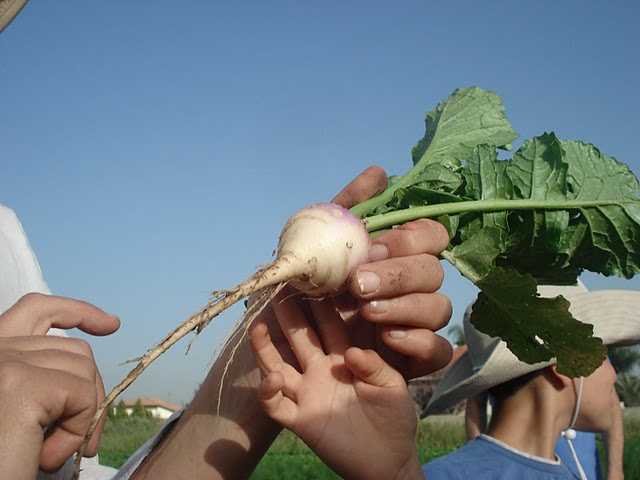
The turnip also boasts medicinal uses. Assaf the Physician (Assaf Harofe Ben Brakhiyahu who lived in 6th century Tiberias) sang the praises of the turnip’s greens and seeds: “The greens aid in healing mental distress and malaria, while the seeds help treat pain and all kinds of lethal poisons.”
According to Nissim Krispil, turnip greens can be used to treat hoarseness and coughs, throat phlegm, and respiratory ailments. In natural medicine, turnip juice is used as a mood-booster (highly needed these days) and is also beneficial in kidney treatment. Turnip roots contains calcium and potassium. A quaff of turnip-green juice helps neutralize excess acidity in the blood, strengthens bones, hair, nails, and teeth. Five hundred grams of turnip root produce a cup of juice that treats anemia, arthritis, asthma, menstrual disorders, bladder obstructions, heart disease, helps lower fever, and boosts kidney, liver, and lung functions. Five hundred grams of turnip greens produce half a cup of juice (one quarter for the morning and one quarter for the evening) to treat coughs, hoarseness, and hair loss.
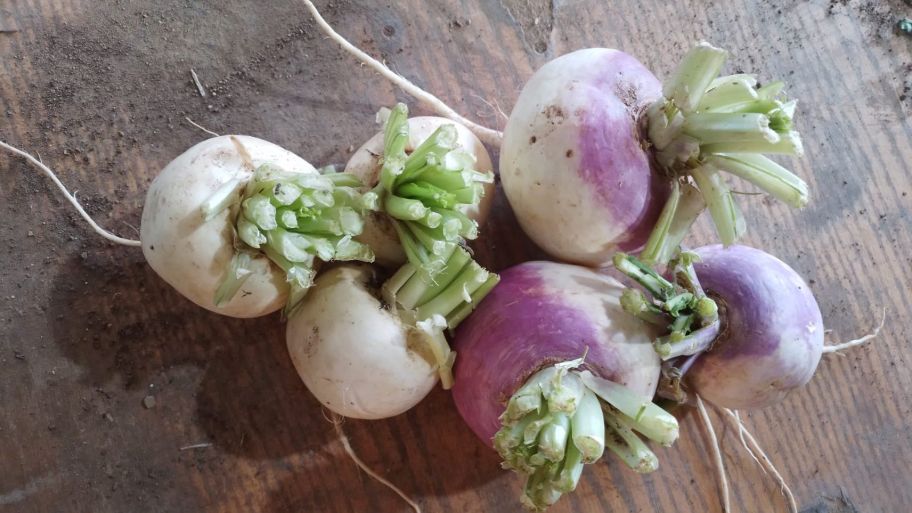
Turnips enhance soup, meat stews, and chamin. Use turnips like you use carrots (glazed, steamed with butter, caramelized), or potatoes (chips, mashed). Add long, thin raw turnip slices (shaved off with a peeler) to garnish a vegetable salad, or pickle young turnips for two days without pre-cooking, in a sweet and sour brine made by boiling together a cup of regular vinegar, a cup of water, and a cup of sugar.
At Chubeza, we proudly grow two varieties of turnips – the familiar turnip topped by a stylish purple stain, plus a special variety – a white, round and very sweet turnip. Even confirmed turnip haters must try this yummy delight!
L’hitraot and B’tayavon! May we speedily see the return home of all of the hostages!
Some healing is needed,
And it's okay, it is near,
This is just the bad that comes before the good.
Alon, Bat-Ami, Dror, Orin and the entire Chubeza team